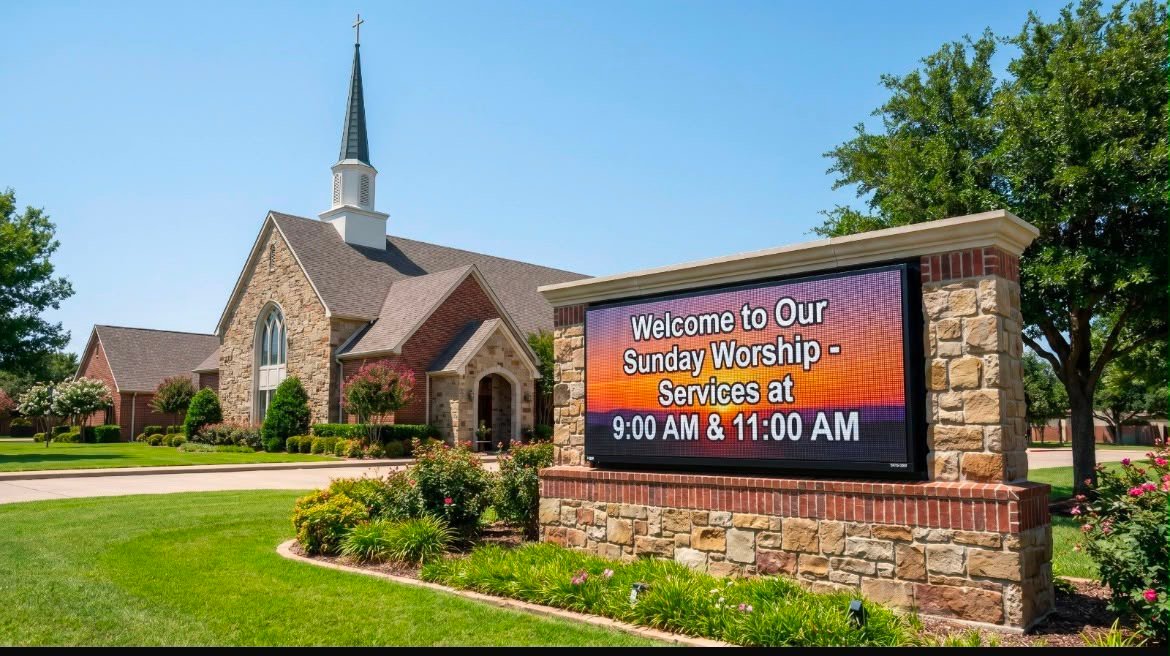
What this display format is designed to do
A roadside business LED sign is planned for an audience moving past the property. Message length, letter height, display size and orientation should reflect the actual road, setback and approach rather than a generic sign package.
Speed sets the message budget. At 45 mph a driver covers about 66 feet per second, so a sign readable from 500 feet is in view for roughly 7–8 seconds. That is about one short message. Local hold-time rules of 6–8 seconds reinforce the same discipline: one idea, short words, large characters.
Typical specifications
| Planning factor | Typical range or rule of thumb |
|---|---|
| Typical pitch | 10–16 mm for 35–55 mph roads |
| Reading time at 45 mph | A driver covers about 66 feet per second |
| Letter height rule of thumb | About 1 inch of character height per 25–30 ft of reading distance |
| Message hold times | Commonly 6–8 seconds minimum in Wisconsin codes |
| Faces | Double-face for two-way traffic on undivided roads |
Where it can be a good fit
This format is relevant for businesses, schools, churches and organizations that need to change public-facing messages while keeping them short and readable from the roadway.
Decisions to make before requesting a quote
- Approach direction and traffic speed
- Setback and available sign envelope
- Single-face or double-face visibility
- Message length and dwell time
- Structure, power and local approval
Frequently asked questions
How big should a roadside LED sign be?
Work backward from speed and setback. Faster roads need larger characters to be read sooner. Use about 1 inch of letter height per 25–30 feet of reading distance, then fit the display to the allowed sign area.
How long must a message stay on an electronic sign in Wisconsin?
It depends on the municipality. Appleton and Fond du Lac require 8 seconds, and state rules for off-premises highway signs require 6 seconds. Check the specific city or village code.
Should a roadside sign be single- or double-faced?
Double-faced signs reach both traffic directions on undivided roads and usually cost less than two separate signs. Single-face is enough when traffic is one-way or the sign is perpendicular to one approach.